If you exploit the name of Cagliostro in any manner, you should run to cover a moment after reading this newspaper answer to the question “Who was Cagliostro, and what is the present-day application of the name?” The answer. “Cagliostro was Giuseppe Balsamo, an infamous charlatan, impostor, faker and literary thief, who assumed the title and name Count Allessandro Cagliostro and toured Europe towards the close of the eighteenth century, posing as a miracle man. He was born in Palermo, Sicily, in 1743, and died in jail at St Leon in 1795. Hence, the name Cagliostro is applied to any literary cheat, faker, forger or humbug.”
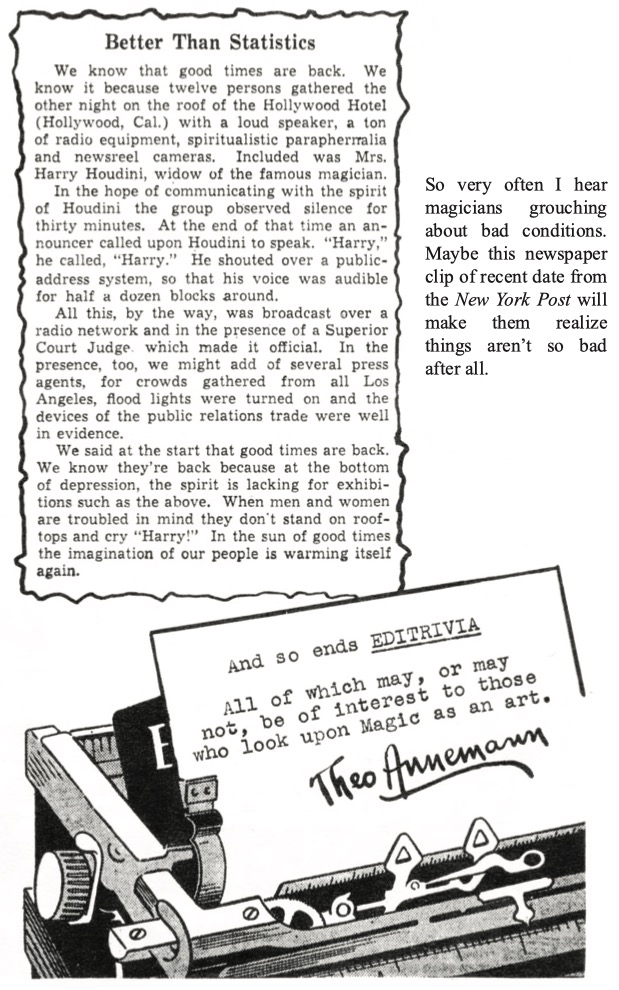
When I met Dr Edward Saint on his recent trip east, he very kindly gave me one of the signed invitation card to the final Houdini seance held on the west coast. The seance was on October 31st, I received my invitation on Nov. 23rd, but maybe it’s just as well, because I heard that nothing happened anyway.
There’s an interesting story about Hermann and the bullet trick that has never yet come to light. It seems that Hermann did the stunt by switching the initialed lead balls on a metal tray while on their way back to the stage. Several years before Madam Hermann died, she had his old assistant take the tray on a ferry boat between New York and New Jersey and drop the thing in the middle of the Hudson river. — Incidentally, Frank Ducrot still has some leaden balls that belonged to Houdini, but I’ll give a life subscription to anyone who’ll show me where there is any record of Houdini ever doing the bullet catching trick.
Bob Gysel sent me a clip of the fellow who was jugged in a Newport, Kentucky jail, and, although searched every time (and right down to the nucleus, too!) he still managed to produce ten dollar bills and fifty cent coins and call for cigarettes. The story hit the air waves too, and it strikes me that a gag like that would be a marvelous publicity idea for any magus who gets incarcerated. I mean, of course, for a very minor infraction.
Ed Wolff, of Rochester, New York is publishing his methods of hypnotism. I knew him for quite a while before I ever found out he was such a person, but when I did find out, it was in a practical way. I played the Rochester Ad Club, and in two days time, with a lot of sweating and concentration, I went on for 15 minutes over WHAM and broadcasted the hypnotising of a lady over the telephone from the control room to the studio. The publicity and pictures were very acceptable. There’s no reason why his methods can’t do the same for you.
It’s interesting to know something about the name of this sheet. Christy Mathewson, the major league pitcher of old base-ball days coined the word “jinx” as a synonym for hoodoo. Today there are four major league magical amateurs on the subscription list, and three more whom I know have purchased at least one copy.
A book from India just popped in. Titled Card Sleights and Tricks, (don’t ask me how I know) it is the first and only book of its kind ever printed in marathi, and has been assembled by Dr K. B. Lele after 25 years of study.
I am intrigued by the illustrations, at least, and now I have only to go to Poona-Poona to find out the secrets. I sincerely mean it though, when I say that his monthly The Indian Magician (in English) is one of the rare buys of magicdom. The July issue, just past, carried a full page of ads, the weirdest thing I’ve ever seen — and I’ve written a lot of ads.
Do you, you or you have a printed program? If you’ll send it to me, I’ll stack it with the few I have now, and print them all at a near date. I have lots of the bigger prof. programs, such as Thurston, Dante, Blackstone, etc., but I want those of semi-professionals who put on shows and have a program for it. I’ll appreciate greatly any sent me, even if you have someone else’s whom you’ve seen.
Here’s an extremely neat idea for those who have one or more of the Davenport card silks. Dr Jacob Daley has been making the transition from card tricks to silk tricks in this smooth manner. Take a ten cent, and hollow, rubber ball. Cut a three-quarter inch hole in it, and about three-quarters of an inch from the side of the hole push through, from the inside, a length of good elastic cord, knotted on the end so it won’t pull through. This makes an easily held handkerchief ball pull. Run the elastic from right side around the back to left side through the belt straps, ending after going through the one on the left side. Put a silk into the ball with the tip of same easily securable. After too many card tricks, force the one, the picture of which is on the silk. Lay the deck aside, and as you reach for the card with your right hand, turn a bit to the left, and the left hand grabs the ball. A trial or two will enable you to get it right each time. Bring the card, face outwards, back to the left hand, as you turn still more towards the left, and the left hand comes upward with palm downward but turns towards the audience as it goes behind and the left fingers and base of the thumb grasp the card. The right thumb and forefinger now reach up, and very quickly pull out the silk from under the lower edge of the card. as the right hand flicks the silk out, the left hand drops a little, the ball is released and disappears, whereupon a remark is made about the card carrying a handkerchief upon which its picture appears (very appropriate where picture cards are used). The card is flicked aside, the silk shown, and handkerchief effects are in line to follow.