
This effect is totally new from the audience’s point of view and that is something to be looked for in this day when effects are pretty difficult to evolve.
The performer states that very few people have a retentive mind and remember what they actually see. He states that in every accident case, there are contradictory stories about what actually happened. To prove his point he takes a deck from its case and shuffles.
Passing to a spectator and holding the deck very openly and fairly on his left hand he asks this party to lift up the corner and look at the top card. Without a move or suspicious action, the performer passes to a second party and they are requested to do the same and also remember the top card. Lastly a third party is asked to look at the card and very openly the performer deals it onto the spectator’s palm or on something where it is in full view.
Now the performer repeats that he has made an actual test of his statement that no two people see things exactly alike. The first party is asked to stand and name the card he saw on top of the deck. He does. The second party then arises and names the card he saw. He does but it is a totally different card. The third party stands and names the one he saw and it is still a different card! The performer shrugs his shoulders and tells them that they are all wrong. The third man turns over the card on the table or that he is holding and it is the Joker!
The deck may then be tossed out if desired.
It will be readily seen how the effect lends itself to comedy if not too blatant. The effect upon the audience is good and will always be remembered. I advise the performer to call attention at the start that he is not performing any sleight of hand or card trickery but is just making an experiment in observation.
METHOD
Like all good things, the actual working is simple and makes use of one feked card as per the illustration.
A half hour’s work will make this card and it is composed of only two cards to start with, a picture card and a
deuce.
Cut the picture card in half down through the middle.
Cut the deuce in half across the center. Both cards have thus been halved but in different directions. Now put these two halves in a dish of cold water and leave for fifteen minutes. Then split each one half way. Cut off the split back half of the deuce and the front split half off the picture card.
Without letting them dry and without adding any paste or glue whatever, lathes halves together as pictured, put between clean blotters and let dry overnight under a heavy weight. If this is done cleanly, neatly and accurately, as is very easy, you have a perfect looking card from the back (except for the missing corner) and it is as flexible as any other card in the deck.
When perfectly dry take a good rubber eraser and you can rub out half of the pip on the deuce. Now with jet black India ink, very carefully draw in the Ace of Spades as illustrated. Then it is ready to be used.
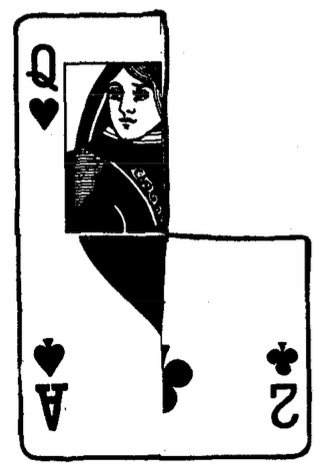
Lay this card on top of the deck and have the Joker underneath. When you take the deck from the case, shuffle but keep these two on top. The cut out end is nearest you. Now hold the deck face down on your left hand with the cut out end still at your end. As long as the cards are kept squared the backs blend and the cut out cannot be seen.
After using the patter theme suggested step to the first party and have him lift the right hand corner of top card and note it. Without making a move, step to another person at a little distance and have him do the same, but he lifts the left corner and notes card. All you have to do is present this corner to him for him to lift without saying anything other than that he is also to note top card. It is rather strange but somehow no one seems to realize that the index would not be at that corner and if the deck is held so that is the corner nearest them, and at the same time the performer tells them to also lift and look at the card, they will do it. Thus two people have seen different cards without performer changing position of deck in hand or making a move.
Now the performer starts toward third party and merely squares up the deck very simply and openly but in doing so
turns the deck.
This party also lifts and looks at the right hand corner. And immediately afterwards, the performer very deliberately
deals the top card face down onto the table. However, the missing corner of the feked card makes a perfect second
deal possible and the Joker is the one dealt.
The effect is over except for the climax. During the naming of the cards and the general interest and comment caused
at this time, the top feked card is palmed off pocketed very simply. This leaves everything clear and a great
impression has been made.
They’ll consider you a great card man and will talk about the way you must have switched or changed the cards and how
fast it must have been done.
Originated by Eddie Clever.
In the “olden days” you didn’t have any choice — you had to create your own gimmicks. But today with places like The Game Crafter you can have a bunch of gimmicked cards printed for a few bucks. I don’t really do card tricks, but I really want to make up this gimmick! (And by that, I mean design it and then have TGC print it!)