
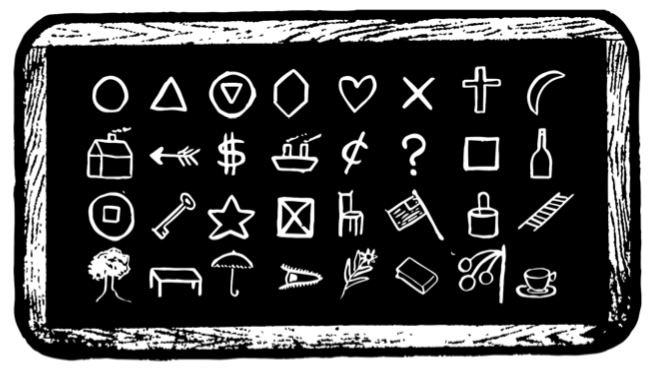
One of the greatest effects in thought transmission is the coding of pictures freely drawn by the audience. It goes without saying that it is at the same time the most intricate of methods. Julius Zancig was most adept at this feat and developed it over a period of years through undisputed ability plus a thorough grounding in transmission secrets.
What I am presenting here is a poor substitute for what that master could accomplish, but in itself and as far as it goes, the effect is quite marvelous to an audience and at the same time satisfying to the most exact performer in regards to cleanliness of working.
One needs only a set of 32 five inch square cards and a large slate with chalk. These cards are made of white drawing board. This can be obtained from stationary stores in sheets about 22 by 28 inches in size. On one side of each card is drawn a simple sketch with black drawing ink. The sketches are made very heavy and as large as possible. On the illustrated slate I have drawn the ideas I am using myself, although any others can be put to use. (Ed., the strange object fourth from the left in the bottom row is said to be an eye.)
Effect
The set of illustrated cards is freely shown to consist of 32 different and simple ideas. The performer says that he will try a test of thought transference with members of the audience. Pictures will be used rather than letters or figures because they are better visualized in the mind.
The cards, as the performer speaks, are mixed in a fair manner (but not shuffled like playing cards) and then placed in a stack with drawing sides down on the slate.
Approaching a subject to be, the performer asks him or her to pick off a number of the cards in a bunch and hold this stack with face of same close to their body for the time being.
Without touching the cards left on the slate, the performer passes to another and has them repeat the procedure. The few cards left are put aside and the performer stands a few yards in front of one spectator with nothing but the slate and chalk in hand.
For the first time the assistant is asked to look steadily at his drawing and concentrate upon it. It may be mentioned that at no time can the performer see either the face or the back of the drawing being looked at, and that the selection has been left to chance.
However, the rest of the audience will know that and it is best not to emphasize the points.
Drawing something on his side of the slate, the performer asks the spectator to show his drawing to all. Turning the slate, the performer shows his sketch to be the same! Passing to the second spectator the test is repeated, this time the performer drawing on the other side of the slate, and again the drawing is duplicated!
And everything can be left with the audience if desired!
Method
The pictures are stacked. Not in any memorized order but on the slate and across the center is put in pencil the 32 sketches quite small. They are in the same order as in the pack. Hold the pack with faces down in the left hand. Take a bunch from the top with the right hand and apparently mix the two bunches together. Really though, a few from the top of the right hand are left on the bottom of the left pile and then a few from the bottom of the right pile are left on the top of the left stack. Repeat this manoeuvre until all right hand cards are gone and repeat the gesture if desired.
Do this loosely so that it appears like at random and you have the best false mixing possible. The stack is only cut and this doesn’t matter.
The first and second spectators cut off a bunch each and hold.
When you lay aside the few remaining, you drop them face up and your fingers have spread them a little so the identity of the top card is known to you. The second spectator’s picture will be one behind (to the left on the slate’s list) this drawing. Note it while telling the spectator to look at the drawing and then draw it on the clean side.
When both have been shown, take the bunch from the spectator and lay aside in the same manner. Spotting the top card of this packet, you know the identity of the first spectator’s card when you start drawing on the other (list side) side of the slate. Arrange this sketch with heavy lines so that it blocks out the list.
I doubt if a cleaner method of duplicating pictures can be devised for one person. From the viewpoint of the audience it is convincing and more than fair in every way.
It sounds like Annemann is describing the Charlier Shuffle — there’s a quick video here that will show you how to do that: https://youtu.be/NCPnOLxEZ6E?si=XHs-blEjN5ThvVKA
Also, I did something a little bit different with the crib than just drawing it on the slate — you can see what I did here: https://open.substack.com/pub/exclusivemagic/p/they-can-see-it-but-theyre-not-looking?utm_campaign=post-expanded-share&utm_medium=web