

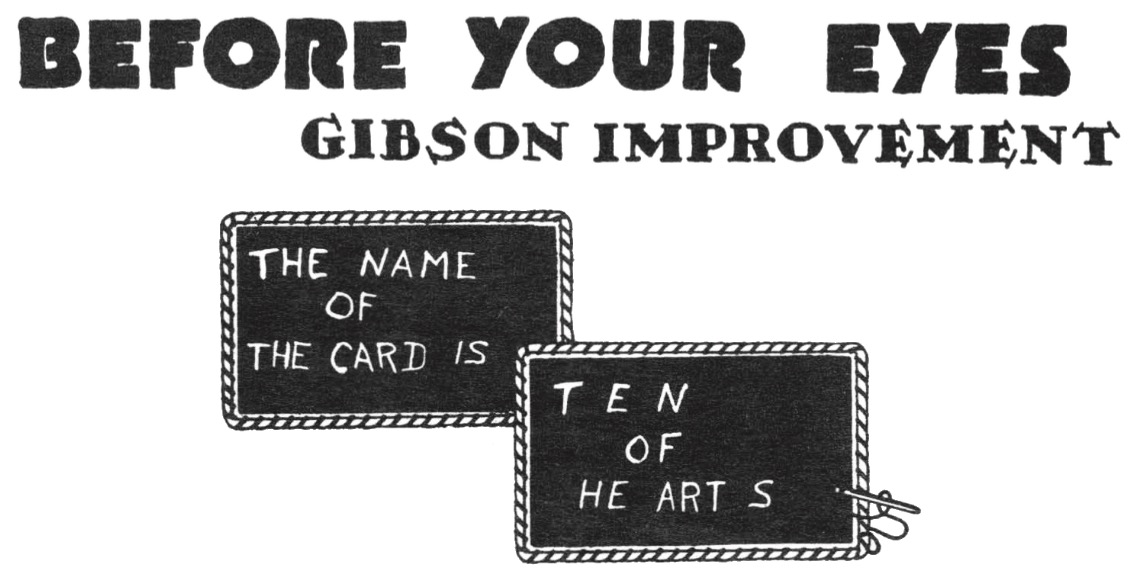
If someone were to dig out the 20 best Jinx effects during the past 82 numbers, including Extras, Before Your Eyes, by Norman Ashworth (Jinx #32), would have to be included. That number is out of print now, and this great improvement must needs explain the effect fully for those who can’t refer to their file. On a slate the magician chalks the words seen in the first illustration. He lays the slate down and has a card selected. The spirit of a departed friend, he says, will reveal the name of the chosen card upon the slate. When again looked at, the slate shows no change. The performer says it to be strange and he’ll have to try again. He rubs out the writing. And as can be seen by the second illustration, THE LETTERS VANISH WITH THE EXCEPTION OF THOSE WHICH SPELL OUT THE NAME OF THE CHOSEN PASTEBOARD!
Use an ordinary slate with a flap for it. On the slate proper paint the letters for the Ten of Hearts, spacing them properly. Next fill in the proper empty spaces with chalk letters to make up the sentence shown. Cover this with the flap. To present, pick up the slate and write the sentence openly upon the flap, exactly as it is on the slate proper underneath. Lay it writing side down on a table while the card is forced. Pick up the slate leaving the flap behind. IT appears the same as when first written before their eyes. Then erase, and the chalked letters disappear leaving the paint ones for the novel and startling disclosure.
There have been two difficulties to surmount, the getting rid of the flap, and the forcing of the card. Howard Brooks, the night club magician, did the first by not using one. HE picked up a slate already prepared with chalk and paint but didn’t show the fixed side until after he apparently had written the message with chalk. Then someone nearby would hold it over his head until time for the finale.
Walter Gibson has devised a method which gets away with the flap and eliminates the force at one and the same time. Follow this closely. The slate is prepared in the same manner as always. The Ten of Hearts from the deck is then placed face down upon the writing and the flap is then put on top of both. A second slate, unprepared, is on top of the prepared one, and a deck of cards on top of all.
The cards are handed someone for shuffling. The top slate is removed and placed under the arm. Next the sentence is openly chalked upon the flap of the second slate. The spectator who has mixed the deck is asked to stand, fan the cards face down before himself, draw any one he wishes and put it, without looking at it or showing it to anyone, face down upon the writing. The other slate is then dropped on top to cut off all light and give the happy spirit a chance to see the card and write its name for all to see.
During this short interval the slates are turned over together which lets the flap drop to the unprepared and former top one. Then the prepared one, now on top, is lifted. The same sentence (?) is seen, and face up on the other slate is seen the Ten of Hearts, apparently the card which was picked out by the spectator and put upon the slate himself. The spectator is asked to take his card back and show it to all. The slate with flap (and the other card underneath it) is again put under the arm while the sentence slate is shown, talked about, and finally wiped off to reveal the correct words of revealment.
Thus the stunt is done without forcing, and away from tables in the middle of the floor with people on all sides. Those features make it an effect worthy of any program.
Leave a Reply