

Just a few years ago I would have taken this idea, put a full page ad in the Sphinx, supplied a book and deck of cards, made a price of about three dollars, and sold from 100 to 150. I’m rather proud of the way it has worked out, and it is a direct result of the effect Between the Lines that received much in the way of plaudits in the May issue.
Whereas Between the Lines was a straight book test with the word revealed at the finish, The Oss of Lhasa is a prophecy, fair and very square, of the word to be selected under the same conditions. Therefore, it makes a very nice method to follow in repeating the trick. And I mean it when I say that it will confound magicians because they will know the book used is an ordinary one and cannot be faked. And you needn’t worry about anyone figuring it out.
In short, I have discovered a very simple method of arranging cards at will, so that although different combinations show up and may be selected, the word will always be the same! Thus you can write the prophecy on a slate beforehand, and let them have their way.
METHOD
Follow this closely. Take a book of straight reading matter. I used Gone With The Wind. Start with page 12.
Jot this number on a sheet of paper and look at the first line. Look for a common word among the first ten, like “and”, “that”, “this”, “to”, etc. If you find a word of this type, mark down its position in the line next to the page number like this (12-4). Now continue through the book to and including page 98 looking for this word among the first ten, putting your findings in a column under your first figures as above. Thus you will have a list of every page on which the word appears among the first ten, and the figure denoting its position from 1 to 10.
There must be no duplication of figures in the page number and word position, such as the 3rd word on page 23, the 5th word on page 52, etc. Neither do you look for a word on any page that is numbered with a zero, such as 20, 30, 40, etc. These rules also eliminate such pages as 44, 55, 66, where the two figures are alike. However, the 10th word on any acceptable page is all right even though there is a figure 1 in the page number. That’s because there is a 10-spot in the deck. Otherwise, the three figures, page number and word position all must be different before they can be listed in the reference column.
Take Gone With The Wind for instance. I looked for “and” and my column looked as it is given here, the first two figures representing the page, and the third one meaning the position of the word in line.
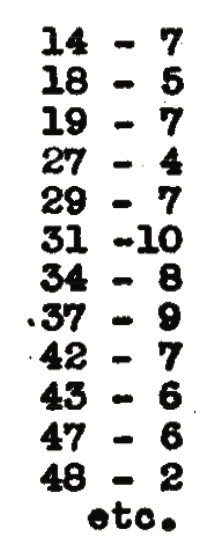
There were other “and” words but they were in a position to clash with the page number so were left out. Now taking playing cards from Ace to Ten from a deck. Look at your table and lay the cards out in groups of three to represent combinations of page and word numbers. You must use 9 of the ten cards. One such combination would be 2-9-7, 3-A-10, 4-8-5. In this particular case, the 6 spot was left over and discarded.
There are always three or four possible combinations that will use up 9 cards, and you only need one. Now put pictures cards between the sets of 3, which are in correct order according to the table, from back to face. Now the packet reads: 2-9-7-J-3-A-10-Q-4-8-5-K. Make up four packets like this from the deck, discarding the six spots, and pay no attention to suits. Put them all together and you have a stacked deck which will select “and” in Gone With The Wind or whatever book you are using, and whatever word you are working on.
Put the book and the deck on the table for the spectator. Give it a false shuffle and cut it a few times. Tell them you will make a prophecy. Write on a slate and lay it down. Walk away and ask the spectator to cut the deck a couple of times. Then he is to deal off three cards in a face up row from left to right. If a picture card is among them he is to push them all away and deal three more, repeating this until he has three spot cards before him. Tell him to take the first two cards and open the book at that page. You explain that if the cards are a 2 and 4, he is to open the book at page 24, etc. When he has the book open he is to look at the third card and count to the word at that number. Then the word is named and you finish by showing the prophecy correct.
In Gone With The Wind I found three words. I give them here, together with the stacks that will find them. Cards are given from back to face of the deck, and only 12. Repeat three times.
THAT – 3-9-7-J-A-6-8-Q-5-2-10-K etc.
AND – 2-9-7-J-4-8-5-Q-3-1-10-K etc.
SHE – 2-5-7-J-A-4-3-Q-8-9-10-K etc.
The word “that” appeared only eight times up to the limit page of 98 in a position where it could be used, and yet it was possible to make up three sets of cards with no repetition of figures. “She” only appeared 11 times. “And” appeared 22 times in usable positions and FOUR different stacks can be made to set the deck, while only one is needed.
Thus it is possible to obtain words that are not too common if one spends a little time. But for the common words mentioned here, any book can be “cased” in half an hour or less.
This same principle works as well with a magazine like Liberty, Collier’s, or The Saturday Evening Post. Just use the pages on which reading matter appears.
And for those who really get around a bit and want to use the effect, it doesn’t take much effort to “case” a few of the popular books and current magazines, jotting down the stack in your notebook. You’ll hardly find a home or place where you can’t pick up one of the copies you have listed, and the effect becomes that much greater.
Leave a Reply