

Our greatest magical regret is that we never saw Houdini on the stage. It hurts because, unlike Kellar and Hermann, we missed a performance of the arch mystifier and master publicist by but a few months. When mother woke us on that morning of October 31, 1926 with the paper that carried his picture on the front page we cried. As we can analyze it now, 14 years later, and with the name of Houdini still, if not more, important in every type of literature as a noun-verb, it must have been in anguish that we had lost an opportunity to tell our cult in later years that we had witnessed magic by the world’s best recognised mysticist since Moses threw down his staff and caused it to appear as a snake.
Houdini’s escapes were, for the greater part, of a sort to be beyond the possibilities of the average conjuror. In his book Magical Rope Ties and Escapes one of the very best impromptu deliveries was his Full View of Audience Release. This effect is another of the simple yet completely mystifying methods of escape.
A piece of cord which has a small loop formed on one end, is threaded through both sleeves of the performer’s coat, which he continues to wear, through the armholes of his vest, and through four buttonholes, and the free end of the cord is then threaded through the loop at the other end, and after being passed under a door or a screen, is given to a member of the audience to hold. The performer appears unscathed and completely together while the rope is found in one long length, also unscathed.
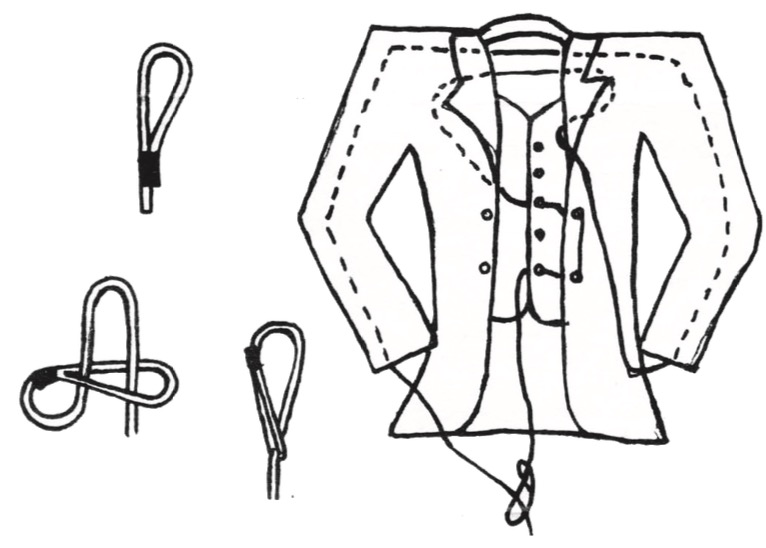
The cord to be used must be strong and soft. It should be about 8 yards long and of a color to make the effect “showy.” On one end a loop is formed (about 1 1/2 inches long) as per the sketch.
The end of the cord, on which the loop is formed, is taken in the right hand, drawn up the right sleeve, passed across the back, and taken down the left sleeve, leaving about three feet of cord hanging free of the sleeve. The looped end is then passed into the left armhole of the vest, across the chest and out the right armhole. It is then threaded through one of the buttonholes of the vest, from the back; then through another buttonhole in the coat from the front, and finally through another buttonhole in the vest, from the front.
Then the end of the cord, which is hanging from the right sleeve, is apparently threaded through the loop at the other end. In reality it is passed through a noose formed on the cord by putting a portion of the standing end through the loop, as shown in the sketch.
To escape from the cord, it is necessary to pull about three or four feet of slack through the buttonholes, open out the running noose till it will pass over the head and shoulders, pass it over head and shoulders and step completely through it. It will be found now that the cord may be pulled straight through the sleeves and leave the performer free of all bonds.
Leave a Reply