

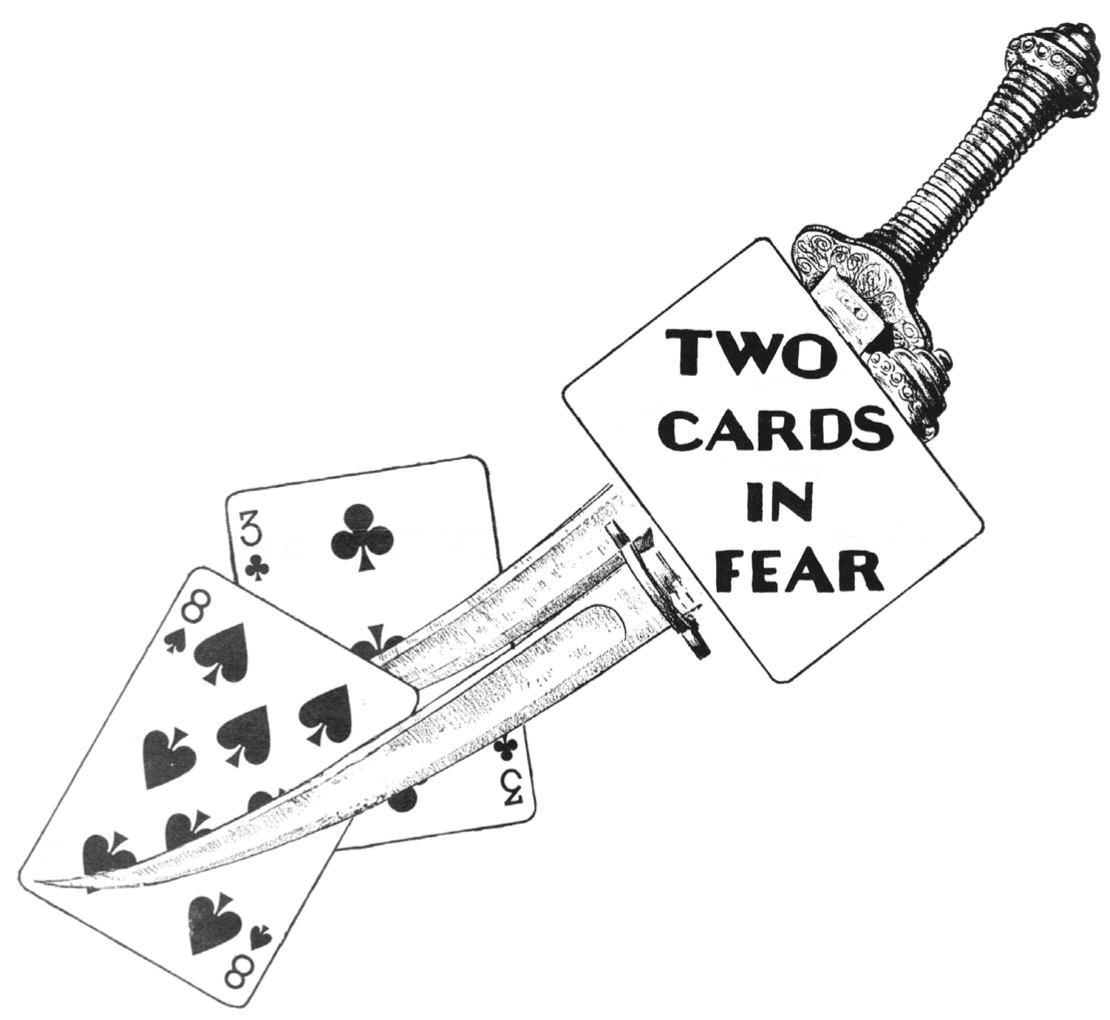
Well, wouldn’t you be in fear with a couple of fancy, but sharp, knives looking for you? And especially so knowing they were in the hands of irresponsible spectators who didn’t know and didn’t care where they were stabbing?
Of course, magic itself is not logical, but it has always seemed to me a bit incongruous for a knife to be thrust into a pack and selected cards found on either side. With two cards chosen and shuffled back it is quite a little miracle just to have them come together in the pack. This version of the stabbing trick uses two knives and two spectators. It is a double location with the cards found in different spots.
The only requisites outside of an ordinary deck are two knives, preferably of an arty type with different colored or shaped handles. Paper knives offer a wide choice. A sheet of newspaper (about quarter size tabloid sheet) is at hand.
Two spectators stand on each side of the performer and each selects a card. We shall call the left-N°1 and the right-N°2. N°2 returns his card first.
It is brought to the top and during a riffle shuffle another card is added above it. The deck is then undercut for the return of N°1’s card (onto the original top of the deck), the lower half is dropped on top and a pass made which brings the two chosen cards with an odd one between to the top. A Hindu shuffle may also be used instead of the pass. As matters stand now the N°2 card is third from the top and on top is the N°1 card. In between lies an odd card.
The deck is now sprung lustily from hand to hand which serves to give it a downward crimp. Then, in straightening, only the upper two-thirds is sprung upwards. Finish this action by cutting the deck which buries the chosen cards about twenty and below the bridge which has thus been made. The deck must be so crimped that pressure at the ends will cause the cards to bridge at this one-third position from the top. You may hide this bridge by pressure of the right index finger in center of the top of the deck while it is held between fingers and thumb at the ends.
Take the piece of newspaper and wrap the deck. Give spectator N°1 a knife. Hold the deck by the ends with right hand and request him to plunge the knife through the SIDE of the deck. As he is ready to do so, you put pressure on the ends, the deck inside paper gapes at the bridge, and the spectator can’t miss.
Transfer the deck and knife to the left hand, holding the deck this time by the sides from above. The N°2 spectator now pushes his knife through FROM END TO END, and as the first blade is but a third from the top there will be no difficulty in having the second knife penetrate BELOW.
The two knives form a cross, each being through the deck at right angle to the other. The stabbed deck can be held to freely show the situation. Then the paper is torn completely away. The deck and the knives are held face down in the left hand, handles to the left and rear. The blade crossing from left to right through the sides lies between the 2nd and 3rd fingers.
The N°1 assistant names his card. The right hand grasps the blade of the side knife, and with thumb holding cards above it against the blade, the packet is turned over to the body as you say that the chosen card never is above the knife, but always below. With the little finger of the same (right) hand as you finish speaking, the top card of the lower half of the deck is flipped over to show correct. If this seems clumsy you may have the spectator remove it and show.
The knife and packet in the right hand are now laid aside. The remainder of the pack is left in the left hand with the N°2 knife running from end to end.
As the N°2 person is asked for the name of his card, the right hand covers the deck with the fingers at outer end and thumb at inner end. The blade of the knife is between the 2nd and 3rd fingers. The left little finger is inserted UNDER the top card (odd card) and firmly against the back of the second card. As the card is named the knife and top half of the deck is removed by hinge motion to the right to again show the card is not above the knife, and this action covers a slip pass of the second from top card onto the top of the lower half. As you finish talking with “always below” the card is flipped over as described before, or the hand is extended for the N°2 spectator to remove and show his card.
I want to emphasize the “second card from the top slip pass.” Slipping the TOP card to center or the top of the lower cut has long been a standard sleight, generally used as a force, or stop location. One had to watch his angles, though, for people on the performer’s right always could get a flash of the top card leaving if they weren’t misdirected. By slipping the SECOND card, NOTHING can be seen to move from any angle – the hinge movement of the right hand plus a slight turn over to the right of the left hand packet in an open effort to indicate by pointing the face card of the top half – acting as a complete cover of the card being transferred. A few trials with your right side to a mirror will show how utterly deceptive this is. Those who still would like to keep to the old track merely have to bring the cards to the top of the deck WITHOUT having any odd card between. But once tried I know this new top slip angle will be a favorite.
Leave a Reply