

“Before you think,” says the performer, “I’ll write something for you — something that may occur in the near future — an event, or happening over which I can have no possible control.”
And that is a general opening remark to a type of trick which has been ever popular with both mystery workers and audiences. The prophecy of occurrence — whether it is a number to be thought of, a word to be pictured, or a playing card to be chosen.
I’m not going to attempt a history of this work. It might come later to be included in a veritable bible for mentalists of which I’ve dreamed, but for now only a phase, a subtlety of inestimable importance and value, can be the subject.
Two foundation principles have been useful – the piece of carbon paper for late impression via a penciled reference note, a stylus gimmick for the same purpose, but secretly, or a writing lead gadget for a directly written notation upon an unsealed surface.
A third principle is that of the pocket file — an index of notes which cover all possible selections under the conditions made. In position for accessibility to the nth degree, these notes are ready for substituting for the prophecy apparently written before the event or selection has taken place. This prophecy (dummy) is generally put into a hat or bowl and palmed out secretly. Later the correct paper obtained from an index is introduced into the container as it is picked up and handed a spectator.
Magi have differed as to the construction of indexes and most have been impractical. For proof the reader has only to wonder why he hasn’t used the principle, and whether or not he knows someone who did. From here on I’ll attempt to make very clear, and very attractive, what I’ve done, and why.
Over 15 years ago, Al Baker conceived of substituting written on papers for playing cards, in the then very popular pocket indexes. Herbert Brooks was in these United States featuring the effect of producing any card called for. The idea was a happy one but no one ever seemed to make anything of it all. The card indexes were themselves too big for notes, and WHILE THE INITIAL USE OF INDEXES DID NOT HIDE THE FACT THAT ONE WAS GETTING SOMETHING FROM HIS POCKET, THE USE OF SUCH GADGETS FOR SECRETLY OBTAINABLE NOTES ENTAILED TOO MUCH FUMBLING FOR THE MISDIRECTION POSSIBLE. And that’s my answer as to why “pocket prophecy” tricks have not been among the popularly used subterfuges.
A year or so after Baker’s conception I received a letter from the late Bob Gysel wherein the idea was explained. I thought it immense, for at that time magic and myself were just getting underway and I didn’t know so much that I could analyze the faults which evidently had stymied, or held up the others.
Like the proverbial fools who rush in where angels fear to tread, I made up a set of indexes to hold and “give” 52 pieces of paper. I used what was handy and followed as closely as I knew how a few written but not illustrated descriptions of the Brook’s indexes which corresponding amateur magi had swapped for something probably much to the bad.
The indexes served me well, for it was almost six years later, after I had reached, by devious routes, New York City, that I finally had to make a new set. And after constant use for that length of time (I’ll be frank and say I can’t remember any engagement when I haven’t used an index of sorts) there were but two minor changes that I made — practically for ease in getting ready for a show — not for any decided advantage in the actual working.
So, after 14 years, I honestly think that what can be written here is the last word to date. In that time it’s a rough but underestimated guess that the two sets I’ve made (the second set is getting old and has been patched but after 8 years it is wearing like an old shoe) have seen use on over 700 shows.
To this date (February 24, 1940) only three people have looked at my indexes. I thought too much of them. And those three were members of my immediate family, for even Mr. Baker never saw them. Of late, however, there has been a definite “pick-up” of index consciousness and pocket “pick-outs”. It has made a number of the boys run in circles with all kinds of ideas for their paper slip containers. I’m detailing the very best of the effects I could evolve during the 14 years only because I now have the Jinx to keep well fed, and because it’s a crime whenever some people try to do a trick without the proper equipment, and I don’t want to be an accessory before the defect.
Let’s take up the mechanics of the indexes first. With that out of the way, effects and possibilities can be covered.
Use a pack of cards, not of the Bridge, but of the regular size. They don’t have to be new, but at the same time they don’t have to be old. It is preferable that the cards be of good linen quality rather than of the ten cent store paper type.
Other tools and accessories are a ticket punch, scissors, ruler, 3 paper fasteners of the type about 3/4 in. long with shanks that spread out, and a box of paper fasteners of the V type that fold over the end of papers and then are pinched together. A paste pot and a hammer complete the workshop tools.
The indexes are the size of a playing card and we’ll take up the making of one. Both are exactly alike.
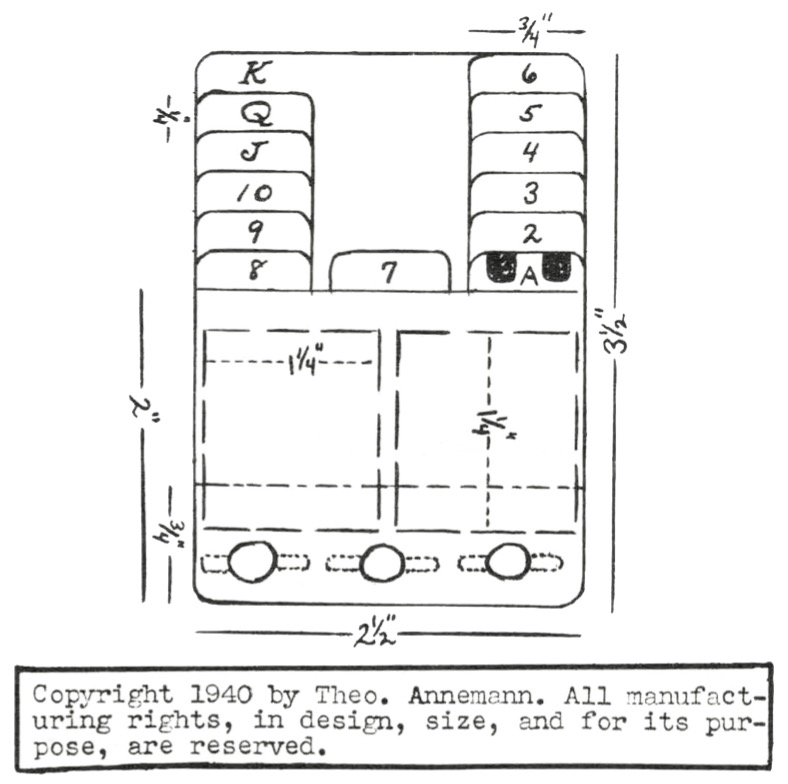
First, cut up enough cards to make 13 pieces 3/4 in. by 2 1/2 in. One card will make four such pieces, the playing cards in a regular size pack being 3 1/2 in. x 2 1/2 in. At 3/8 in. from one of the long sides and equally spaced, punch 3 holes for the shank clips later on. These 3/4 in. strips are to be used as “in betweens” for holding papers later on and are important.
Now there are 13 index parts to cut, each one different from the other. Keep cards in front of you during this description, check it all with the illustration, and we’ll call the nearest (to you) end of the cards the bottom – the far end, the top.
Take the first card and cut it cleanly across just two inches up from the bottom.
Take the second card – cut it across from left to right – two inches from the bottom, but leave a tab on its right edge – just 3/4 in. long and 1/4 in. high.
Take the third card – cut it across from left to right – two inches from the bottom, but leave a tab on its right edge 3/4 in long, BUT THIS TAB IS TWICE AS HIGH AS THE FIRST – 1/2 inch.
The fourth card – its tab is the same width, but it is 1/4 in. higher than the tab on the third card.
The fifth card – its tab is 1/4 inch higher than that on the fourth.
The sixth card – its tab is 1/4 inch higher than that on the fifth.
The seventh card – its tab is the length of the card.
PLEASE KEEP IN MIND WHEN LOOKING AT THE ILLUSTRATION THAT THE NUMBERS SHOWN THERE ARE INDICATORS OF PLAYING CARD VALUES AND THAT WE ARE ONE AHEAD OF THOSE IN DETAILING THE CUTTING OF THE INDEX CARDS.
The eighth card (7 on the sketch) has its 3/4 inch long and 1/4 inch high tab in the center.
Beginning with the ninth card (8 on the sketch) the tabs are found on the left side of each card. Each is 1/4 inch higher than the last, and this continues through the 13th (Q on sketch) card. The last, or 14th (K on sketch) card is left intact and it acts as a backing to protect the rest of the index cards and tabs.
Next at the bottom of these 14 cards, and at the same positions as was done with the small “in between” strips, punch three holes.
Then comes the assembly. Put the three shank clips through the first square cut (no tab) card and lay it on the table so the shanks are sticking upward. Onto these three shanks you put the remaining 26 punched pieces. Next goes a narrow strip – then the second card (Ace tab) – next a narrow strip – then the third (2 tab) card – a narrow strip – fourth (3 tab) card – and so on until finally the whole (K) card completes the pile.
The shanks are now bent apart and pounded flat with the hammer. You can hurt only the table and your thumb so don’t be afraid to make it all very secure.
The last operation is to use the V shape clips on the edges of the tabs as shown on the Ace tab in the sketch. Each tab gets two. These were a later improvement to protect the edges and make them much easier to count in the pocket.
Now for the loading. Upon 52 pieces of paper, 2 1/2 x 2 1/2 inches square are written the names of the cards in a deck. Keep the suits separate. Fold the papers once each way. Each index is made up to contain all black, or all red. Two of these papers, each representing an Ace, go into the first section of the index IN FRONT of the Ace tabbed card, and ARE PUSHED IN BETWEEN THAT CARD AND THE NARROW BINDER STRIP AT THE BOTTOM. Without that strip the indexes are not worth a cent as holders. Keep all the Hearts on one side and all of the Diamonds on the other.
Then fix the other index in the same manner using the black cards. Don’t mind if the newly filled index flares out like a stuffed fan. It takes a week or so pressed tightly before they close down as much as they will.
Two such indexes placed together with tab sides inward and in a reversed position to each other are just about the thickness of a pack of cards. Keep them in a heavy telescopic type of card case. That holds them flat and protects them.
In your trousers pockets, the tab sides are TOWARDS the body, and the thumbs do the finding. Any paper can be found with a maximum of THREE counts – from top down, or bottom up in either tab row. The thumb is pushed into the opening and it forces out whichever paper is wanted.
And that’s the most practical paper holder I’ve yet to see or try out. It holds the largest size paper slip of any, and in the pockets lays flat. Blocks of wood with holes in them may be all right for up to 10 papers, but not more than that, and not any too good then. The index for Zingone’s Dual Prophecy trick was worthy of ten years in the bastile. The papers were tiny and you had to be an accomplished piano accordionist to find your place. Besides you always were knocking others out of place.
THE ORIGINAL EFFECT
The indexes are filled with papers bearing names of cards. The performer asks a spectator to shuffle an ordinary deck, and while this is taking place the performer writes something on a slip of paper, folds it, and drops it into a hat, or cup. However, he finger palms the slip, on which he has written JOKER. The spectator is asked to think of a card, and then to remove it from the deck and place it on the table, face up. A few seconds are taken up with queries as to whether the spectator was “made” to take any particular card. The proper paper has meanwhile been secured, and that hand picks up the hat or cup with fingers inside (dropping the paper) and offers it to someone. This person removes, opens, and reads the prophecy.
This effect also can be worked as pure mindreading by having the person think of the card before the performer writes.
LADY AND GENTLEMAN
This was my own combination of the indexes with the “two souls” trick of Baker’s. It eliminated the necessity of counting. The indexes are loaded with papers reading “The gentleman will get the —- (name of card) –.” A deck is stacked with your favorite system of arrangement. Approach a
lady, false shuffling the cards. Put them on her hand and ask her to keep
her mind a blank while you write something for her. Scribble anything on
a piece of paper, fold, and pretend to put in a hat or bowl. Finger palm it
out.
Now tell her to give the deck a cut. Then she is to look at the top card and push it anywhere into the deck and square them up. Take the deck from her and hand it to a nearby gentleman. He is to shuffle the cards while you write something for him. However, you have glimpsed the bottom card and therefore know what card the lady has looked at. On another piece of paper you now write “The lady will choose the — (writing the name of the card she DID take) —.” Fold and openly drop into the hat. Now have the gentleman choose a card in the same manner.
Ask HIM the name of his card, reminding that you have written something for each BEFORE they acted. When he gives it, turn and ask the lady the name of her card. This gives the necessary ten second stall in order to secure from the index the gentleman’s card. Then pick up the hat, dropping paper inside with the other, and have someone else read them off.
A variation here is to let each person keep his and her cards. Then they cannot alone name them but show them as well, keeping both cards and paper prophecies as souvenirs.
THE OMEGA CARD PROPHECY
This is really my reason for writing this article. I couldn’t explain the trick correctly without describing the index so figured I might as well cover as much as possible.
Years ago Walter Gibson thought of a cute angle wherein you could hand a deck to a person or he could keep his own in hand, shuffling them well. Turning the deck face up he would then separate the cards, one at a time to avoid any mistake, into two heaps, red and black. These heaps he then turns face down and picks up one. Then he turns over two top cards, adds them together, and counts to that position in the other pile.
During this time the performer has written something down and laid it aside. The spectator reaches a card and shows it. Then the paper is read. The performer is correct ! And remember that this is done impromptu without the performer touching a deck he has never seen before !
The secret lay in the fact that the cards were dealt singly into face up piles. The performer stood watching but noted the first two cards dealt into either heap, knew their total, and thus could count the cards falling into the other heap until he saw what card hit the preferred position ! During the rest of the dealing he busied himself writing the name of this card and putting it out in view. The spectator turned the piles face down and picked up one. If he picked up one pile he could turn over the two top cards and add. But if he picked up the other pile he was told to put it in his pocket for the moment so that it couldn’t be tampered with. Then he was told to turn over the two cards on the other pile.
Now imagine this improvement due to the unknown presence of indexes. The performer has the spectator shuffle his own deck while he writes a prophecy (dummy) and puts it in a cup to one side. Of course, he palms it out. Then the dealing is done. The moment the performer learns what card is set in the deck, he has eons of time to secure the correct paper, pick up the cup, and move it closer to the dealer or hand it to someone else to hold.
Thus everything is done before the spectator is through dealing, the performer has ostensibly written his prophecy BEFORE any dealing was done, and another spectator is holding the actually correct paper BEFORE anyone sees the card to be chosen, apparently by chance. Could anything be more open and fair appearing to an audience.
ORVILLE MEYER’S TWIN PREDICTION
Two predictions are written, each on a slip of different color. They are dropped into a hat. Two spectators count down to a number mutually agreed upon and note the cards arrived at. The predictions, BOTH of which were written and dropped into the hat BEFORE the pack was handed out, prove to be correct.
The Meyer method excludes indexes and makes use of but ten pieces of paper, each bearing the name of one of the ten Hearts. They are in order and held together with a paper clip so that the Ace side of the packet can be told in the pocket. The ten Heart cards of the deck are arranged from Ace to Ten from back to face of the deck and an indifferent card placed between each. An indifferent card is placed on top also which leaves the ten Heart cards at even numbered positions. The deck has a short card at the bottom, and the performer notes and remembers the indifferent card on top.
After a false shuffle and cut the deck is handed to one of two spectators. Pick up a white slip of paper (the set in the right trouser pocket are white also), look at man with the deck and write something (anything). Fold it and drop in full view near the hat. Look at the second person and pick up the colored slip. On this you write the name of the indifferent card on top of the pack. Fold this paper and drop into the hat. Then pick up the white slip and pretend to put that in also, but finger palm it out.
The person holding the pack is asked to name aloud any number from 1 to 20. No matter what is called the performer will cause one of the Hearts to be arrived at, as for instance, in the case of 11. Performer would ask helper to count off 11 cards, one at a time (reversing them), then look at the NEXT card, and place it also on the counted-off pile. Had 12 been named, 12 cards would be counted off, and then the last or 12th card looked at and replaced. In either event, a card at one of the even numbers is arrived at, and by halving the number the performer knows the identity of the card looked at.
The helper now drops the remainder of the pack onto the dealt off pile and gives the deck a couple of cuts. The performer takes the deck, gives it another cut and brings the short card to the bottom again. Then it is given to the second assistant to count off the same number of cards as did the first man, (11), look at the next, etc. The second man always is told to do exactly what the first man was told to do, and this automatically forces the original top card of the pack.
During this last procedure the performer’s right hand holding palmed slip has gone to the pocket, dropped it, and removed the clip from the packet of papers so that the Ace side is against the thumb. From here on it is a simple matter to thumb off papers to the proper one, and this is finger palmed.
With the second card noted, the performer reaches into the hat, pushes the palmed slip to the fingertips, picks up the colored slip already there, brings out the hand with slips showing, and hands the correct one to each person. Of course, everything turns out to be perfect, and everything stands examination.
For those who can make a pellet switch by hand, the two original papers (dummy white one and correct colored one) can be left in full view on the table throughout. At the last moment, with the correct slip finger palmed, make a straight switch for the white one in handing it to the assistant.
We know that number 7, 13 or 17 will be named more often than others. In the above effect these would represent the 8th, 14th, or 18th cards, or the 4, 7, or 9 of Hearts. By writing the name of one of these cards on the first slip, if one is using the sleight of hand switch, quite often it will not be necessary to make any switch at all !
THE IMPROVED BUCKLEY METHOD
Mr. Meyer’s system of stacking the cards was contained in the Buckley effect of about 15 years ago. However, his handling of the papers is much simpler and as practical as was the block of wood with holes in it. Also, Mr. Meyer dispensed with the idea of having a number on one paper to tell the subsequent location of the selected card, changing this part to make possible the prediction of two cards rather than one.
Now we can take the Buckley idea and use it in conjunction with a full set of 52 papers via our pocket indexes, predicting a card to be selected by one person and also predicting the position it will be in the deck afterwards.
The deck is stacked a la Si Stebbins, or in the “Eight King” fashion. The suits rotate over and over in your favorite order. Now you have to practice a little behind the back subtlety which was given me several years ago by W. John Gallagher, of Cairo, Egypt, and which to date has not found a precise spot in these pages. Give each of your right four fingers the name of a suit, using the order in which your cards are stacked. Now touch each finger in turn with the thumb of the same hand, over and over, saying to yourself only the values of the cards as stacked — A, 4, 7, 10, K, 3, 6, 9, Q, 2, 5, 8, J, A, 4, etc., or 8, K, 3, 10, 2, 7, 9, 5, Q, 4, A, 6, J, 8, K, 3, etc., depending upon which system you use. Whenever you stop, you note which finger your thumb is then touching and that tells you the suit. Thus you are able to run through a stacked deck in your mind as fast as your thumb can count.
False shuffle and cut the deck a couple of times. Note the bottom card as you place the deck before a spectator. That tells you the top card’s identity, the place from where he will start counting off.
Now write upon the colored slip, “and the card will be found 14th from the top of the shuffled deck.” Scribble anything on the white piece of paper. Fold both and drop into the container, finger palming out the white one.
Now ask the spectator to think of any number from 1 to 52. Then he is to start dealing the cards off one at a time onto the table so as to make no error, and when he reaches his card he is to look at it. You are standing with hands behind back during this and, knowing the first card, you easily keep pace with the dealing and when he stops you know his card immediately. He then is told to show it to one or two people nearby and finally to shuffle it back into the deck thoroughly.
This has given ample time for you to secure the proper paper slip, drop it into the container as you hand it to someone to hold, and then you take the well mixed deck. Say, “I want you to be certain I haven’t done something of a tricky nature and taken your card away. You must be sure that it remains in the pack, and that no one but you and a couple of friends are aware of its identity.” As you talk you fan the deck through, standing beside him, watching the cards go by. As you reach his card you start counting and when you pass the 14th card, including his, keep a break in the pack, and continue on. He says that his card is still there. You cut the deck at the break and give it to someone to hold.
The white paper is read first. It correctly names the card. Then the second paper is read. The climax comes when a spectator counts down to that number and finds the chosen pasteboard. And the helper will always swear he shuffled the deck very thoroughly afterwards and no one even touched it !!
FINAL NOTES
That just about winds up the definite ideas regarding the pocket index principle. That there are any number of ideas yet to be originated for their use cannot be denied, for it takes only a concerted effort on the part of many magi to produce an exhaustive supply of material on a certain subject. That it hasn’t been done before is, as I have said, because the devices were not practical. I KNOW THIS ONE IS for it has aided greatly in my living for a long time. I know, too, that each reader will immediately try to improve it, and I wish them luck because I can’t. I honestly doubt if it ever will be feasible to have all the papers in one pocket instead of two. There are certain restrictions that are not worth overcoming for other faults will then appear to annoy you.
Outside of the realm of cards one might play around with the idea of using slips containing first names. 26 male names and 26 female names of the most common type might be indexed, and used in conjunction with some other type of definite prophecy, such as a forced answer to a problem, etc. The system of two papers as used in the LADY AND GENTLEMAN effect could be used, and the effect presented as a combination of prophecy and mindreading. The lady would be asked to think of her mother’s or father’s first name, a paper written (?), and a prophecy could then be made for the gentleman. He would be forced into the result desired, and the correct name for the lady secured from the index. With the common names the percentage of success would be high, and if the performer didn’t have it in his pockets he would merely bring out the one closest to it depending upon the sound. Then he’d have the prophecy correct, and be very close on the mindreading, with the excuse that the lady didn’t concentrate well enough but just thought of the name hazily.
I suggest that all who do put this principle to work try and develop the ability to change the papers by pure sleight of hand rather than use a receptacle unless absolutely necessary. And if you have any troubles — please write.
Leave a Reply