

The following effect consists of two distinct parts, each of the two being practical for use in conjunction with some different trick. The “force” of a playing card is a typical Tom Seller’s idea and quite certain of always working.
The handling of blank cards for an appearing message or name is a Val Evans idea adapted from an ancient card manoeuvre, and, strange as it may seem, is more effective with cards blank on both sides than with blank playing cards. For some reason the watchers are convinced that all surfaces are shown blank, while with playing cards they immediately suspect trickery. In general effect this part is the same as The Ultra Slate Message by Dr. Jacob Daley (The Jinx Winter 1935-1936 Extra), using slate flaps of a larger size, but the method is completely different.
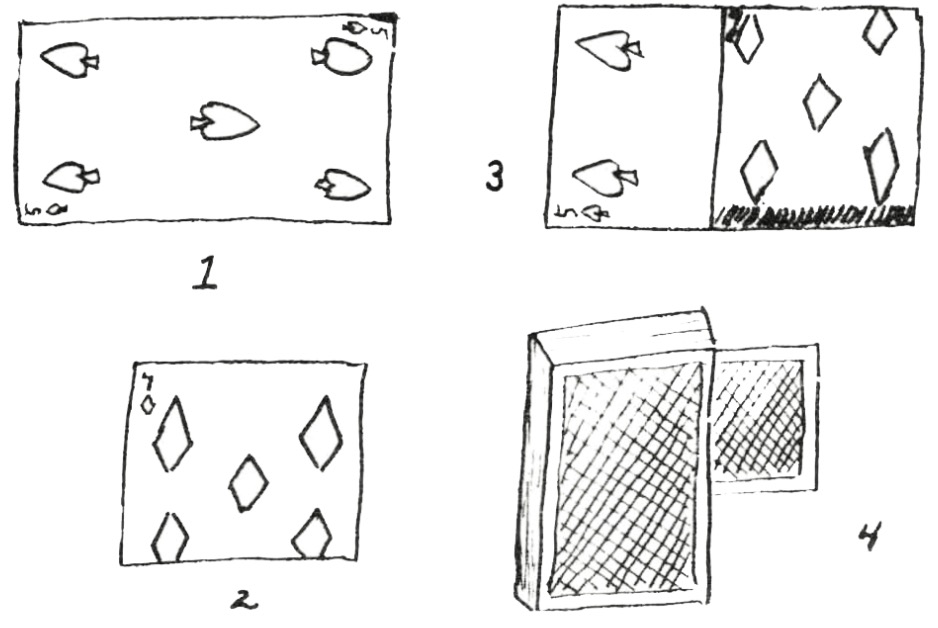
For the “force”, take an ordinary card as in Fig.1, and cut a half card as in Fig.2. This is more than a half card as its length is as wide as the whole card. The half card is fixed to one end of the face of the whole card as shown in Fig.3, and glued along its bottom edge to the side of the whole card as per the shaded section in Fig.3.
This card may be on top of the deck, or added after someone has shuffled. A spectator puts his finger into the end of the pack when you riffle it through. When this is done you take the top card and insert it into the break, as shown in Fig.4. Now the card below the crosswise card is noted and the card looked at will necessarily be the half card – the card you want to force.
Before this apparently free selection the performer has shown four blank cards. These are about the size of playing cards, but may be larger or smaller as is convenient for the performer. On the underside of the second card from the top is the necessary writing, in this case the name or sketched picture of the card to be forced.
These four cards are fanned, writing side down, and then closed and held in the left hand from above with fingers on one long side and thumb on the other. The fingers curl underneath the packet and thus the little finger is in a position for the simple sleight.
The packet is shown at the bottom by the turning of the left hand and then turned back. The bottom card is taken with the right hand and dealt upon the table, thus showing both sides. The left hand again turns showing the new bottom card blank and then resumes its original position. This time the left little finger, aided as much as is necessary by the other fingers, pulls back the bottom card about an inch and the right hand takes the next card and deals it beside the first. Thus the prediction card has been apparently shown on both sides. The remaining two cards left in the hand are shown and dealt in exactly the same manner onto the table beside the others.
“Point to two cards,” says the performer. If the prediction card is one of them he tosses the others aside. If not among them he tells the spectator to throw aside the ones he has indicated. In either case two cards are left and the prediction is one of them. “Give me one card,” next says the performer. If he is handed the prediction he continues without pause, “and into which of your pockets do you want to keep it for the time being?” And upon being told, it is put there. If the performer is given the blank card of the two he tosses it aside and tells the spectator to put the card into one of his pockets.
Then follows the noting of a card. The spectator is asked to state whether or not he thinks the performer could have known what he was going to pick. He’ll say “no.” “In that case,” replies the magician, “do you think that there might be a possibility of an unknown and invisible spirit knowing what you would look at?”
Such a question can leave but a “don’t know” answer, and it is then that the “spirit” does “prove” his presence and power by writing or drawing upon the “blank” card in the spectator’s pocket.
Leave a Reply