


Those in magic for 12 years or more will remember well those effects Poko Chinko (Thayer) and Dis-Kor-Ball (Hornmann). A ball was threaded onto a cord and a number of differently colored discs threaded on the cord. Under a handkerchief the ball and discs were removed. This trick found a very good reception for there was no set up or preparation. It could be repeated at will and it made an excellent “bally” stunt. For quite a few years now the effect has been dormant.
In the present version, which several magicians have said is more puzzling than the original tricky way of securing the ball, a single and not doubled length of cord or shoelace is used with a small wooden “stopper” at each end. The ball is permanently threaded onto the cord, the hole through it being just large enough for the ball to ride loosely but not large enough for the “stopper” at either end to be threaded through it. The discs may be cut from three-ply wood and painted. The center holes in these discs are 1/8″ larger in diameter than the width of the “stoppers”.
A large bandana type or other opaque kerchief is prepared at its center by glueing a round cardboard disc on each side. These discs are of the same size both in diameter and the center hole as the wooden discs used. When dried under pressure, the handkerchief cloth is cut out through the discs center holes, which, of course, coincide. A handkerchief prepared this way will last indefinitely and not tear or rip through constant use.
My experimental set is as follows : The “stoppers” are 1 1/4 x 3/8 x 1/8 inches. The ball is 1/8″ with a 1/4″ hole. The discs are 2″ in diameter with a 1/2″ hole at the center. They are about 3/8″ thick and enameled different colors.
The cord really is a black shoestring and its length when the “stoppers” are stretched apart is about 5 1/2 inches. The handkerchief preparation has been explained. It is 24 inches square.
The ball is first shown well secured to the cord. The performer holds one “stopper” against the end of the cord in such a manner that it may be threaded through the holes of the discs one after the other. They drop along the cord onto the ball and before covering everything appears as in the next illustration. Now the cord is threaded through the center of the handkerchief and held by a spectator.
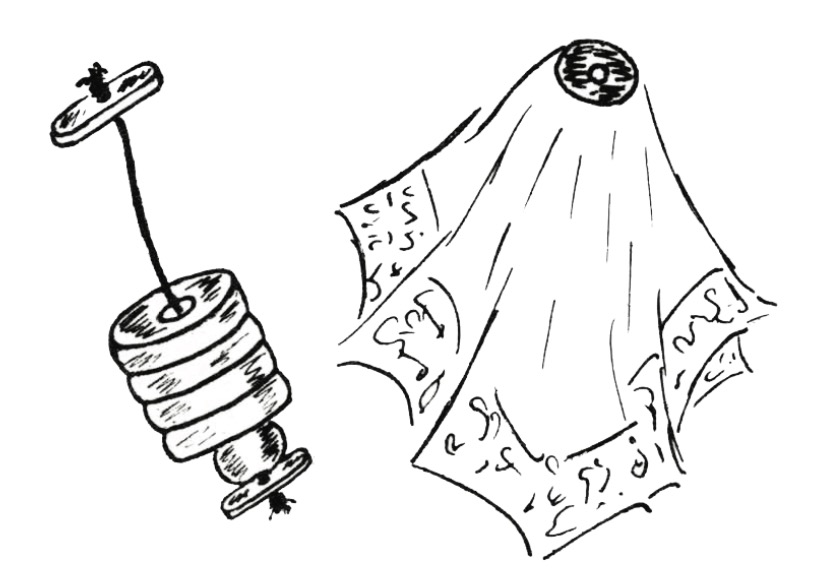
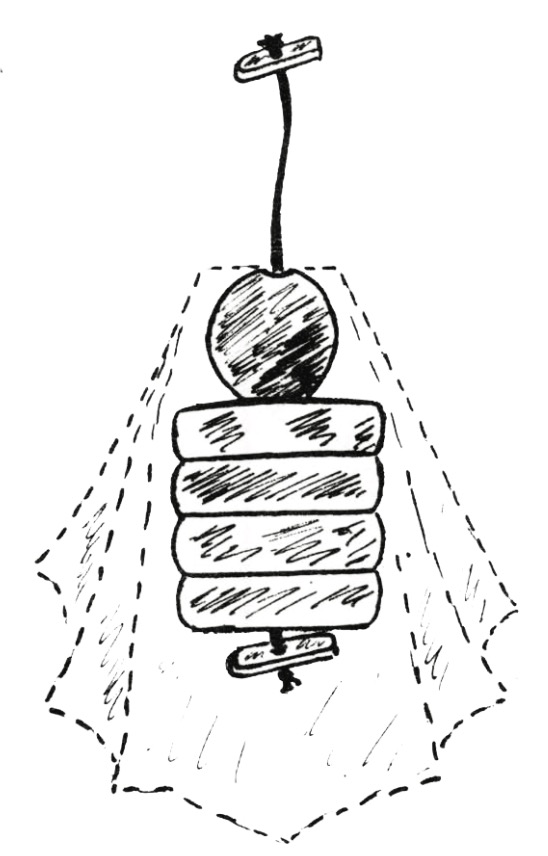
However, there has been executed a subterfuge of great value. The threaded discs were being held by the “stopper” between right thumb and first finger. The handkerchief was shown and thrown over the left hand back up. The right hand goes beneath the handkerchief, the left thumb and finger grasp the “stopper”, the right thumb and finger drops to bottom of stack and grasps the “stopper” there. This is brought up as left fingers now drop the original stopper, and the right fingers thread their “stopper” through the handkerchief. The next illustration makes this clear.
The releasing of the discs is but a second’s effort, and everything may be examined. Only a bit of practice will also show one how easy the reversal is to make with but the one hand under the handkerchief on its way to the hole. When first threaded, keep jiggling the discs as if to show they are constantly on the cord. It will excuse any otherwise noticeable “click” when the cord ends are reversed.
(Copyright 1939 by Annemann. All manufacturing rights reserved.)
Leave a Reply