

When Tom Sellers published a trick called It’s Only Chance in his booklet Novel Necromancy (1935), little did he realize how many varied methods of producing the effect would appear during the next four years. I haven’t kept track but there must be at least a dozen methods of producing the effect of having spectators freely select a flock of envelopes and leave the performer holding the bank, i.e., the one containing the dollar bill.
My contribution to the group of such effects follows. It can be performed at any time (provided you have the money, of course) and at any place. No books, trays, special knives, or stooges are required.
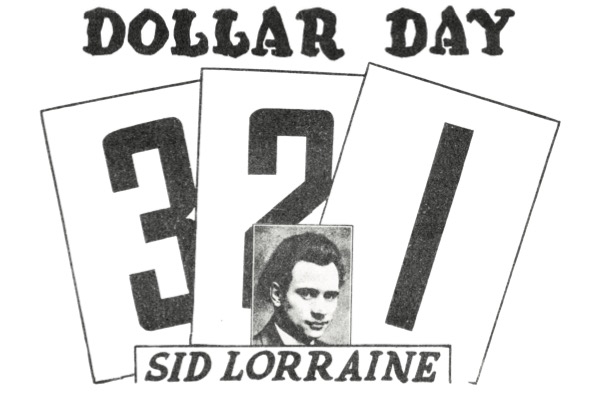
On each of three pay envelopes is painted a numeral. The envelopes are numbered “1”, “2” and “3”. These numbers should be quite large and bold, black showcard paint being used. A glance at the accompanying oil painting will give you an idea as to how they look.
My business card is printed on playing card stock (blanks) and I fold one of these twice. This is inserted into one of the envelopes and sealed. The same is done with the other two envelopes. The folded cards expand and make a definite bulge in the envelope, it being obvious that something is inside.
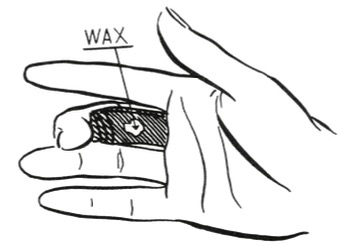
It is now necessary to secure a ten dollar bill for one of that denomination is much more effective than a “one”. Fold the bill (Tommy Martin would use a century note. I think that is a dollar bill that’s a hundred years old.) so it can be finger palmed without bulging over the digits and telling the customers that the performer has cash on hand. (See illustration later in this manuscript)
This folded bill has a liberal blob of wax on the back (take no chances). When the three envelopes are stacked together the bill is pressed to the back of envelope N°3 which is at the rear. The stack of envelopes with the money adhering is then placed in the inside coat pocket until needed.
The routine follows : The three envelopes are removed together and handled as daintily as your mitts will permit. Pass them from hand to hand, one at a time… and call attention to the numbers. You can handle these quite freely and the hands are indirectly shown empty.
Now, square the envelopes together (don’t absent-mindedly riffle them and then make a pass) and as you ask for a number to be selected, secretly remove the bill and get it into the finger-palm position. This will allow you to fan the envelopes with the numbers facing you. As the number is called, remove that envelope and hand to the spectator. Get him to stand up and remain standing until after he has opened the envelope and shown the card. The second envelope is selected and the second spectator treated in the same manner. Now ! All eyes are on the second spectator opening his envelope. While this is going on, you secretly press the waxed bill to the back of the remaining envelope. With your eyes upon the spectator who is opening the envelope you change the hold on your envelope so that it is held at the extreme tips of the fingers, number to the front, of course. When the second spectator exhibits his folded card, call attention to the last remaining envelope and still holding it at the extreme tips of the fingers, tear off the top edge. Reach into the envelope with the first and second finger and withdraw the folded card and AT THE SAME TIME THE THUMB IS BEHIND THE ENVELOPE AND IT DRAWS AWAY THE FOLDED BILL SO THAT WHEN THE CARD IS OUT OF THE ENVELOPE THE BILL IS CONCEALED BEHIND IT.
Toss the envelope aside and slowly unfold the card and find the bill INSIDE. This part is purely showmanship and not at all difficult. You have a handful of card and shouldn’t find any trouble in making the bill apparently come from the folded pasteboard. Drop the card on the floor and quickly unfold the bill and show.
The patter presentation is much the same as in the original Seller’s version. I tell them I’m interested in psychology… I’m also interested in blondes but it’s cheaper to dabble with psychology. Talk about the laws of chance. Tell them it’s Dollar Day in the drug store and that you’re introducing Ten Dollar Day. Explain that a ten dollar bill is folded in one of the three envelopes. Get a fellow to stand up… coax if necessary. Tell him he might want someone to stand up for him someday. Get him to freely select a number. When he does give him the envelope and have him tear it open and read aloud what’s on the card. In this way you get a free advertisement.
The effect is repeated with N° 2 spectator and you are left with the one envelope. Tear it open, drop the card, and unfold the bill. Bow to each spectator, saying “Thank you. Try it on your wife next pay day.”
The audience won’t roll in the aisle (unless you provide the dice) but it’s a handy item for luncheon dates. It can easily be presented as a straight demonstration of psychology with appropriate patter if you don’t want to make it magical. As a matter of fact it isn’t magical. In such a case show the bill, fold and switch it for a flash paper bill. Say that you have money to burn and that you’ll cause it to pass into one of the three numbered envelopes displayed on a stand. Offer to bet the money that two spectators can’t pick out the correct envelope and conclude as described before.
Leave a Reply