


Radio sets of the short-wave type have been tinkered and experimented with by magical acts and dealers for the past six years at least. And, with all the effort so far expended, there are very, very few such sets in operation today. It can be attributed both to the cost and to the complexities of the electronics which go into the making of such apparatus.
For all the experimenting has been done in a “shooting at the moon” vein, the idea being to transmit, by ultra short-wave, the human voice of the performer to the assistant, or the actual voice of a spectator talking into a concealed microphone on the performer. That this will become possible to the nth degree there is no doubt, for all broadcasting companies now use body sets for the transmitting of spot news events and intimate, on the scene, broadcasts.
However, the main fault has been with the concealment of such apparatus. Whereas a man is able to hide quite a bit in his pockets and around his waist, it is almost an impossibility for a woman to conceal anything under modern dress. In such a case, therefore, it becomes necessary for her to dispense with the usual evening gown and resort to a costume of sorts which allows for space. This immediately puts the use of the apparatus into “show” class and prevents it from being used at impromptu intervals, the very use wherein lies its greatest value for the average worker.
Let us go back quite a few years and look at a transition. The first communication system was by verbal and silent codes. With the advent of the telephone transmitter and receiver, the direct contact system was evolved for the sending of information to the medium on stage, both from offstage quarters in the case of written queries, and from the audience for verbal queries, the performer “dressing into his low cut vest” the transmitter. All of this necessitated run-down and aisle carpets, stage rugs, and numerous contact spots throughout. Then came the induction system to obtain offstage information, and which was called the last word because it gave the person on stage much more freedom. This system is being used today in the telephone tapping dictographs.
When the wireless came along, it was father to the thought that one might do entirely away with connections and really “send it” through the air. At that time a set was devised for this purpose. It was compact and cheaply made. That set still works today and is the reason for this article. It never became popular and bandied around because of a simple fact with which experienced operators will agree. No such device of communication (wireless) was practical enough to outdistance verbal or silent signals. Anyone who has watched the Ushers, Zancigs, Sunshines, Mercedes, and a lot of others, will realize the great speed with which they work. It is impossible to duplicate their work, that of transmitting articles and numbers, with the facility allowed by their codes.
When radio replaced the wireless, and short-wave came into being, the thought again popped up. This time, instead of dots and dashes, the actual voice would be transmitted. And so, the race has been on to produce apparatus which would do that very thing, over a distance of from 50 feet to 20 city blocks.
Let’s get down to earth and practicability. I dug up the original wireless hook-up and had it checked by two radio engineers. They all but sneered at such ancient (?) ideas, and, while admitting that it would work, immediately began to elaborate on it by putting in tubes, batteries and other paraphernalia, losing sight entirely of its real value as it stood.
For if two people can transmit a simple buzz between them, without contact and outside of normal hearing distance, and in normal everyday dress, they can run the gamut of all things telepathical. We still insist that no such device can beat the speed and possibilities of code work as used by the old timers, but the present generation doesn’t seem to be interested in making a life study of verbal and silent systems, and this apparatus can be used immediately for many, many mysterious tests, the limit of which depends only upon the individual performer.
For the drawing room entertainer it is quite perfect. For ordinary distances up to 50 or 75 feet and more, a buzzer of ordinary type will serve as transmitter, excited by a flashlight battery, and both carried in the pockets or on a belt. Down the leg is run a 2-conductor cable of lamp cord connecting with the battery and buzzer as seen at figures A and B in the illustration. For aerial and the ground a piece of lamp cord or high tension cable is carried up the back under the coat and down the pant leg as shown.
No danger whatever is present from accidental shock etc., with a buzzer, but for the most reliable work in the largest auditoriums, a small spark coil of ⅛ to ¼ inch spark capacity, should be used. A ¼ inch spark coil can be run, for instance, on 1 or 2 dry cells of a flashlight battery, so as to keep the power down. In this case extra heavy high tension cable must be used for aerial and ground.
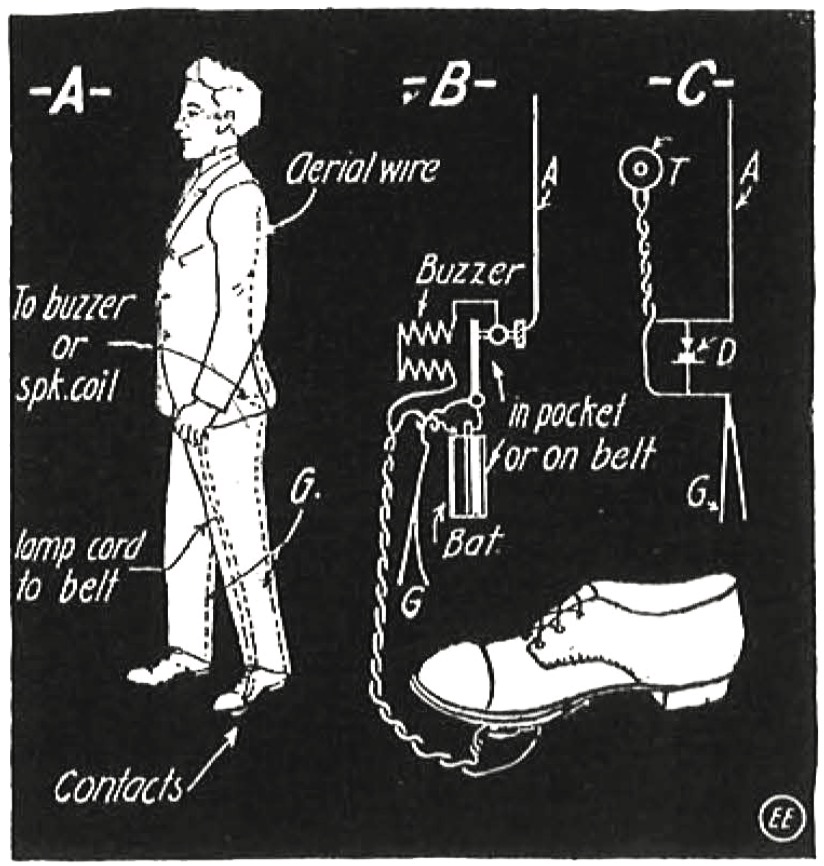
On the transmitter a quenched spark gap is to be used on the spark coil to eliminate the noise, and the buzzer of the coil must be specially built or well muffled to prevent the vibrator hum being heard by the audience.
The coil or buzzer circuit is closed through contact pieces of brass secured under the sole of the shoe. Other contacts may be made to work by pressure against the side of trouser leg, or from a push button key in the pocket.
The receiving end is simply a detector (any constantly adjusted type), and a receiver with 1000 ohms resistance. Thus it can be seen that the woman carries no batteries, and there is nothing to take up room. The earphone is dressed under her hair on one side and the wire runs down the back of her neck.
In her ear, she receives a continuous buzz when her partner closes the circuit. Short and long buzzes can be used ad infinitum.
And what can be done with such contrivance? We will presume the average amateur wants to use it for homes and parties. The medium can be put in a distant room under guard. The performer has any deck spread face up, one card touched by a spectator and thoroughly shuffled. The deck is carried to the medium and she sends back the correct pasteboard. That’s a simple one. The performer touches nothing, merely sees the card, and has ample time to send it to her. Short buzzes are for 1, 2, 3, 4. 5 is a longer buzz. And to send anything over 5 use the long buzz followed by shorter ones. Two long buzzes and two short ones would thus signal 12 or Queen. After a slight pause the suit would be sent by 1, 2, or 3 buzzes. If no suit is sent, she knows it is the fourth one.
Now we’ll try a book test. While she is out of the room, someone freely chooses a book from the case, opens it at any page, and selects any word in the first line. The medium returns, but already the performer has sent her the page number. She approaches the bookcase and passes her hands over them all. A single buzz tells her she is close. She touches individual books at that section and another buzz picks it for her. While she now takes it out and fumbles around for the page she knows, the position of the word in the top line is sent, and all works out well.
Suppose an article is hidden. She returns to the room, not knowing what or where it is. As she passes about the room, a single buzz tells her when she is “hot” and silence informs her when she is cold. As the search narrows down she looks under and around, touching and picking up likely looking articles until two short buzzes let her know she has it. With the article in hand, she can then pass around the room until a buzz tells her she is in front of the owner.
And again, the old murder test is made perfect. Someone acts as the murderer, pretends to stab another person in the room, and then hides the weapon. The medium returns, finds the dead (?) body first, then locates the weapon, and lastly picks out the murderer.
Colors can be sent by both partners having a list of them memorized and merely signaling the number. Unknown problems can be added correctly. Birth dates can be transmitted. The possibilities of this device may not reach to stage routines and performances but for intimate work it will be found very satisfying, and very cheap.
Leave a Reply