

Present this trick in slow motion, explaining to your audience that, while
you use sleight of hand just like any other conjuror, yours is the new
invisible kind. Have a spectator cut any number of cards from the deck
(any number is right), and look at the next card down. He puts his card
on top of the pack, cutting it to the center. Now, in slow motion, without
the slightest move of any kind, the performer runs through the cards and
shows that the chosen card has turned face up in the deck.
The spectator is asked to remove it from the deck and hold for a moment.
The performer patters a bit like this “When a card that is buried in the
center of the deck turns over as that one just did, you realize, of course,
that it must have had to pass through all the other cards in the deck. This
creates a good deal of friction – does the card feel rather warm ? No ?
Your sense of touch can’t be working today. Turn the card face down. The
spectator does this and discovers that the blue backed card is now a nice
bright red. “You see, it’s red hot, just as I thought”.
The performer throws the rest of the cards down, saying “And don’t ask to
see that again for it’s an expensive trick. I ruin a deck every time I do it, for
once a card gets as hot as all that it stays hot indefinitely and nobody has
yet been able to cool it off”. And, while your audience examines the deck
and discovers that it is complete and all blue backed with the exception of
the one red back, you take from your pocket that stacked or marked deck
you’ve been wanting to ring in, and go on from there.
All you need for the effect is a blue backed deck, one extra red backed
card, and a really good force. We give you the latter right here, a force
that is so bold, simple, sure-fire and SO OBVIOUSLY NOT A FORCE AT
ALL that it has fooled some of the best eyes in magic. I’ve been doing it
since 1932 – and keeping it to myself. In that year Annemann published
202 Methods of Forcing. In one of them the force card was on the bottom
of the deck facing up. With the deck held by the performer under a
handkerchief, a spectator cut some cards off the top and the performer
turned the bottom half of the deck over. Until now, getting that half deck
turned over has been the catch.
In the Jinx Summer 1935 Extra, editor Annemann said “It’s one of those
things that just can’t be done without it being apparent that something has
taken place. Even wild arm swings and haywire gestures won’t hide this
fact…” Which is why I call it The Force That Couldn’t Be Done.
You don’t want a wild arm swing, just a smooth easy one, plus two pinches
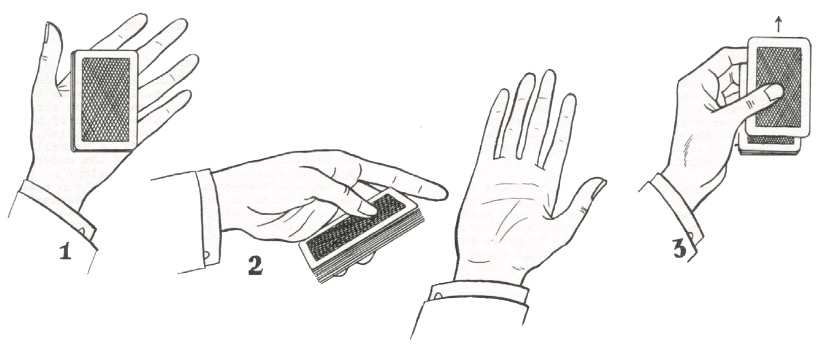
of misdirection. Hold the deck in left hand as in Fig. 1. Have the spectator
cut off any number of cards and lift them an inch or two above the rest
of the deck. Now say that just to be sure that the spectator cut where he
wanted to and not where you wanted him to, that he can still have the
privilege of taking off a few more cards or dropping a few back on. They
always do this and that’s the clincher that makes them swear later they had
a free selection of the card.
And how you do it. Your right hand is held palm up about a foot away
and your left hand swings over and points at the outstretched palm.
Simultaneously you say “Put your cards there, please”. The command,
the pointing finger, the swing of your left hand, the sudden shift of the
spectator’s attention, and the fact that he’s given something to do all make
him and the other onlookers completely miss the fact that you’ve turned
the bottom half of the deck over. Well, almost over. See Fig. 2. The right
thumb has gone under the deck and tilted it to the right onto the finger
ends. The deck has made a little more than half of its half turn.
As the spectator places the cards on the performer’s right hand, the left
swings back to its original position and the deck completes its half turn,
dropping down and lying now on the fingers instead of the palm (If your
hand is small use the narrower bridge deck).
The thumb immediately slides the top card straightforward, see Fig. 3,
while the forefinger presses inward on the end of the deck and prevents
more than one card from sliding out. You must use a back design with a
white margin, of course. Now, while the spectator is looking at his card
and showing it to the others you turn your back so as not to see, and take
this opportunity to turn the left hand portion of the deck right side up and
replace the top half.
As for the red card, at the start of the effect you have it face up and third
from the bottom of the deck. The two cards below are also face up and the
bottom one is the blue-backed duplicate of the red one. After the bottom
card is forced, the indifferent face up card is turned facing the right way
and placed on top of the pack, leaving the red card still face up and now
on the bottom. The spectator cuts the deck, the same way as in the force,
places his card on the right hand pile and puts the left hand pile on that.
The performer immediately fans the deck and finds the face up (red
backed) card. He cuts the deck at this point and gives the red backed card
to the spectator to hold. It’s blue backed duplicate is now on top of the
deck and ready to be palmed off. Throw down the deck and get a new one
from your pocket, leaving the palmed card behind.
When you try this on a magician start with the red card third from the
bottom, then a double backed card and then the blue backed duplicate of
the red backed card. Immediately he has the forced card in his hands, give
him the deck, have him put his card on top and cut. Then let him fan the
deck and find his card face up !
Leave a Reply