

Down through the ages have come but few noted billet readers, and
invariably such men have been able to fool Kings, Premiers, Presidents
and scientists. Dr Lynn and Foster, the medium, were two of renown,
but in the past 30 years one man stood out as a charlatan par excellence
at the business of reading the folded slip. The man was Berthold Riese,
born in 1841 in Posen, which was then Prussian, but now Polish. Later
he became known universally as Bert Reese and before his death in 1928
had crossed the ocean over 50 times to humbug such people as Charles
M. Schwab, Ignace Jan Paderewski, Premier Mussolini, Woodrow
Wilson, Warren Harding and Thomas Edison. Professor Hugo
Muensterberg, of Harvard, became such a believer in Reese’s powers
that he was preparing a book on him when death prevented its finish.
As I look through my file of articles, clips and stories about the doings of
Bert Reese, I marvel at the constantly appearing statements that he never
touched the written on paper. It is a psychological point of importance
to any and all performers who do anything of this nature. Only a trained
observer of such things can give an accurate account of every move, even
though they may not know the method of trickery. What, to the ordinary
spectator, may be the most natural of movements, can be the one detail
that would solve the problem in recounting the experience.
Thus, what may seem like a bare faced and rather open action to a performer
not acquainted with this type of deception, it being psychologically
different in its entirety from the technique of magic, may be looked
upon as a phenomenon by the most educated, and far removed from the
realm of what would be, in their eyes, sleight-of-hand or just trick stuff.
It is important that a performer remember then, that an audience is in a
different frame of mind at the time it watches a billet reading exhibition
and traditionally magical gestures of sleeve rolling or of showing the
hands empty are ridiculous, not mentioning ruinous. The last detail I want
to bring out is that the only really great and successful humbugs in this
line have not demonstrated from the theatrical stage but rather from the
lecture platform and in the semi-privacy of the home and drawing rooms
where the theatrical atmosphere is not present, and the demonstration is
cloaked with a scientific or almost religious demeanor.
Reese did not care whether his subjects called it telepathy or spiritism,
being content to let people credit him with whatever solution of power
they deemed most fitting. Here was a good point as he did not antagonize
any particular group but left it to their own individual credulity and
gullibility.
He ever was ready to demonstrate at any moment or place, another point
which emphasized his benign sincerity of purpose in making use of his
apparently strange faculty.
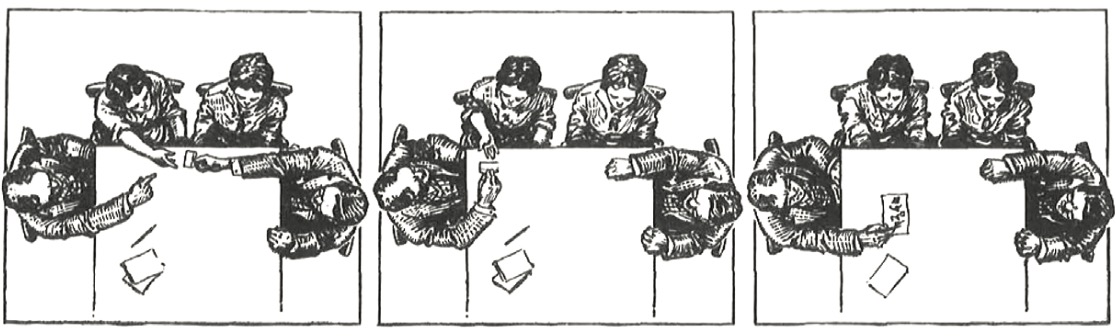
Above has been illustrated one of his routines using three sitters. Reese
is sitting at the left. Borrowing a piece of writing paper, he tore it into
slips about two by three inches. He would be standing at the time, and
this done while the others were sitting down and making ready. Five slips
were put on the table, the rest of the sheet being crumpled up and tossed
away. However, Reese really would make six slips and retain one, folded
once in each direction, as a dummy for his own use. A detail here was
that afterwards, the sitters would relate that he had used their own private
tinted or watermarked paper rather than any of his own. Now he walked
around the room while questions were being written to dead people on the
slips and folded once each way. The folded papers were mixed together
on the table and Reese would take his seat, the dummy billet being finger
palmed in the right hand. He then said “Give one to this lady to hold,”
pointing to the one farthest away, and the sitter opposite him (a man in this
case) would hand her one paper. Reese had not touched it but the pointing
was being done to accustom all to the gesture. “Give one to this lady,”
he’d say next, pointing as before but to the lady next to him. The gesture
was once more planted, and more so when he repeated it again by having
another paper given to the first lady. Now he would tell the gentleman to
keep the remaining two, but as an afterthought would say “Perhaps we’d
better let this lady have another.” This time he would casually take the
slip being passed over to the lady next to him, complete the six or eight
inch journey, but in that space make the switch for the dummy which she
would hold.
The stolen slip was dropped into his lap and opened with the left hand
while, with his right, he’d make marks on a sheet of paper on the table and
apparently get his answer from these while attention was being directed
to them and he was glimpsing and refolding the question out of sight.
Now he would extend his left hand, with the finger palmed billet, towards
the lady next to him, and say “Give me that paper,” pointing not to the
dummy but the other one. Taking this it was apparently opened and spread
on the table, but in reality the one taken was drawn back into the finger
palm by the thumb while the paper in hand was pushed out by the fingers
from where the right fingers took hold and opened it up. Thus the one
opened on the table was the one just answered and finger palmed was a
fresh one. Again the “business” would be gone through and new marks
made and a new answer given. This time a slip from the second lady
would be requested and apparently opened. Following this, the man’s
paper would be taken, then back to the second lady, and lastly the lady
next to him again which would bring the dummy back to him in return for
the final slip.
For single people Reese had a slightly different routine, although
practically everything he ever did was based on one-ahead ideas. Four or
five slips would be given to a man to write questions on and fold. They
would be thrown onto the table as written and Reese would mix them a
little with his finger, but in doing so would switch the dummy for one
paper. As the gentleman was writing his last paper, Reese would walk
away, and in his wandering would open and read the stolen paper. The
single fold each way of these papers made them very easy to open with
one hand. As the person finished the last question, Reese would return to
the table and ask him to put one paper in his left coat pocket, another in
his right coat pocket, one in his left shoe, one in his right shoe, and the
other perhaps inside his watch. Reese only watched to be certain into
which spot went the dummy slip of the five. Knowing the contents of the
finger palmed slip in his left hand, he would walk back and forth around
the room and give the answer. Then he would point to one of the locations
on the spectator’s person and ask for that paper. Taking it, he would open
and read it, aloud, actually reading what was on the slip he knew and
memorizing what he now saw. Folding this paper he would finger palm it
in the right hand and the left hand would toss the other to the table. Reese
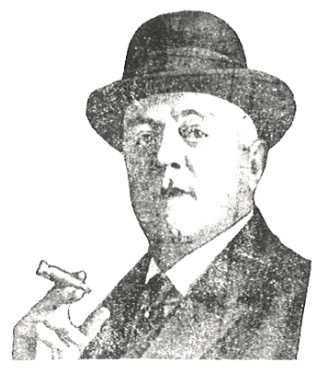
invariably smoked a cigar and the action of taking it from the mouth in
thumb and finger of either hand served as an admirable mask for the finger
palmed paper.
He would proceed by answering the next question and so until the last,
always leaving the dummy in its resting place until that time. It was a
regular procedure of his to have the papers placed about the person in
odd places, such as the watch case, for instance, and my theory for this is
that such places, being unusual in character, were always remembered by
the sitter in preference to the more common spots. Afterwards, in telling
about the ordeal, they could be depended upon to swear that they had put
the paper there and that he had answered it without being near it or them.
Another angle that Reese brought into play often was in asking people
to write the name of their favorite school teacher when a child; the name
of the town or city where they were born; their auto license number;
their telephone; their mother’s maiden name; and any number of odd but
personal bits of information to which he could have no access but which
would be vividly personal enough to the sitter to be remembered and
talked about. Such items are far better than merely having any number or
any word written.
In many cases, when Reese was going to work for someone he knew
of, it was a simple matter to check up on their telephone number before
starting. In such a case, he would sandwich the request for a telephone
number in among the other slips as they were being written. A steal was
made of one of the others and read as described before. Watching the
telephone number slip on the table and also the dummy, he would have
them pocket or conceal the slips as usual. However, when they picked
up the telephone slip he would have it placed in a pocketbook, between
the pages of a notebook, or some other difficult spot. The rest of the slips
would be read as usual, but the telephone slip apparently forgotten. Then
he would recall that there was another slip out, and merely taking the
article which contained the slip and holding it to his forehead he would
answer the question and hand it back. The sitter had been told so many
things no one else could know that the idea of a person getting his number
would never be thought of. Not alone the telephone number could so be
used, but there are many little bits of information about a person that
are dropped by others and of these most anything can be used. Much
information about doctors, for instance, can be secured from a medical
directory and it is possible to have the name of their college on one slip
and the name of a professor at that college on another. The first you know,
and the second request makes it logical to have the other.
Reese, when before a group of people, also had slips written upon, folded
and collected. He would absently pick them up again, hand them to another
person and ask him to put the papers under objects around the room. Of
course, the switch had been made, Reese would light his cigar, and read
the slip in his cupped hands, and proceed to walk around the room to the
various spots and apparently read the paper which was concealed at that
point, leaving the dummy until the last. In all of these variations, it is
to be noticed that the effect was what counted. The stories that are told
about these happenings afterwards are unbelievable. Like the famed Dr
Hooker rising cards, there were so many variations of the same thing that
afterwards, one was put to difficulty to remember exactly the procedure
on each test, and not get them confused with each other.
And now I want to give a bit of information which I doubt has ever seen
print. Much has been said about soft paper that will not crackle as it is
furtively opened. Invariably it has been left to the reader to search out a
soft quality and experiment. Reese used a soft paper but he took it from a
most natural spot. At his home, especially, when giving a test for visitors,
he would pick up a book, and tear out the blank page at the back. Pulp
paper books give you this perfect soft paper and right in front of people
without the necessity of bringing out prepared sheets. This detail alone
was one of his most potent secrets.
I haven’t exhausted, by far, the many incidents and stories
about Reese situations. However, I have given a practical
and working knowledge of how he worked, and the fact
that this man traveled the world over for years, and in the
highest circles, while being looked upon by many as a
competent psychic advisor, proves that such work is worth
developing and extremely effective on the audience.
As far as I know, and I keep a fairly complete file, nothing has been
written about the man for magicians, although reams have been printed
in the press about his marvels. Of one thing I’m sure. This type of work
is more sought after, better liked, and talked about more than any other
phase of the mystery game. And last but far from least, the monetary gain
of those successful in this line far outdistances that of those successful in
other branches of magic. BUT WATCH YOUR PRESENTATION, AND
FORGET ABOUT MAGICAL MOVEMENTS THAT IMMEDIATELY
CLASS YOU AS A MANIPULATOR.
Leave a Reply