

Very few magi haven’t a set of the five dice used in Heath’s Dyciphering Dice Trick, it being one of the few highly effective pocket tricks of the past several years. After using it for a time I discovered several points which make for a subtle test in connection. Produce the five dice and mention that they are used for some money game, (without going into that part further) as an excuse for their being numbered with three digits to a side. Let someone shake and roll them. You line them up in a row, and turning your back ask them to add up the figures and get the total. Then ask them how many figures are in the total. You know, of course, that there are four but ask them anyway. They reply and you tell them to look at the first two and the last two. Toss them a book, apparently picked up at random, and have them open at the page represented by the higher of the two numbers, and taking the other number, count to that word and remember it. You take an ordinary pocket notebook, jot something down on a page, tear it out and hand it crumpled to another. The word is now disclosed. Your paper is read and you have divined the word!
A monstrous variation of this is possible for those who are at home with a set of books or encyclopediae with the pages running consecutively through the volumes as high as 3911. In such a case, you tell them to look through the set and find the page represented by the entire total! Then they are to add together the figures of the total reached and count to that word. You successfully reveal the word in this case too!
I have found that, to the onlookers, the use of the dice make the test appear very fair, and there is never a thought that in the moment of putting the dice in line, or as you tell the subject what to do, you have learned the total by the shortcut process possible with this trick. The opinion they have is that there can be hundreds of variations.
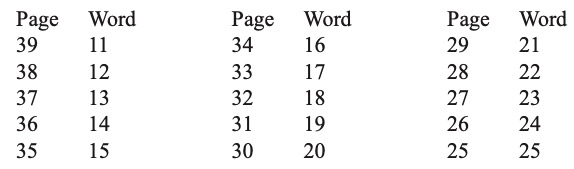
As a fact, there are only 27 different grand totals possible, and going still further, if one separates the four figure totals in half, using them as large and small two figure numbers for page and word, there are only 15 possible words that can be selected! Thus, on the inside cover of your notebook, you have the list of the 15 words followed by the 15 smallest figures in all possible totals, and your information comes from there as you jot something down and tear out the page.
For the encyclopedia variation, there are only 27 pages that can be selected. When you add the four figures of any total you get 14 in every case except two when it is 5. Your notebook in such a case, carries the 27 totals with the correct word after each.
In the first method of the test, the combinations are as follows:
Only a few will use the encyclopedia version and the 27 possible totals are easily figured. You’ll find, upon use, that this method for a book test is very convincing in its fairness.
Leave a Reply