

Historical is the trick wherein the spectator is apparently made to name a card placed face down by the performer and in answer to his queries as to colors, suits and values. The main fault of course, is the constant variance in using or discarding the selection made each time. The layout I’m using for these presentations came to light through Walter B. Gibson except for the handling of the third layout of three which I think original. I included it in my compilation of Forces but it is not a very good force method because it is a long way to go merely for a selection. It is much better used as a climax. Here are two ways of handling it as such.
First stack your deck from Ace to King of each suit throughout with the suits in known order from top. The simpler the stack the better. False shuffle and cut the deck if you can but it isn’t necessary. Tell the spectator you will prove his capability in making right selections and have him name any card in the deck. Now deal the cards face down, one at a time, into three piles. It is easy to follow the simple stack and thus know into which pile his card falls. You also watch and thus know just how far down from the top the card lies at the finish. The 52nd card is placed aside. Have the spectator pick up two piles. If he leaves the right pile behind tell him to place them aside with the odd card. If he includes the correct pile in his pick, merely tell him to give you one of them. If he gives you the right one, tell him to lay the other aside. If he gives you the wrong one, toss it aside and say that you will use the pile he seems to like best.
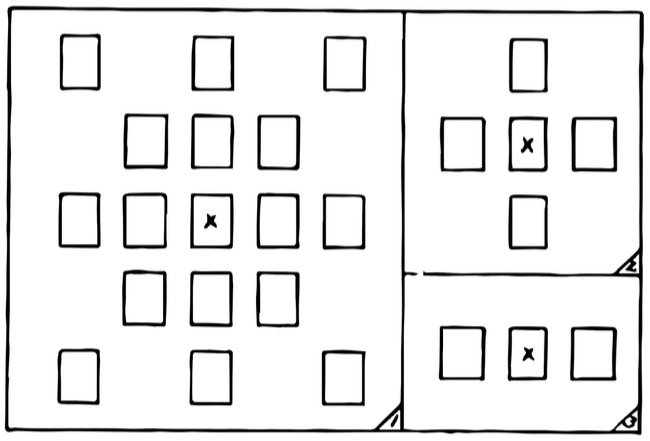
Give this packet of 17 cards a little mixing in a rough or haphazard way but contrive to have the named card ninth from the top. Knowing where it is makes this a simple matter. Seldom more than three or four cards need to be shifted. Now deal the five face down rows as per Figure 1. The ninth card lands in the center. A free selection of any row of five is given. This is picked up a card onto the next and the other 12 discarded. These five are now dealt out as per Figure 2. The middle card of the five thus becomes the middle card of the second group. Now a free selection of either row of three is given. The two remaining cards are pushed aside and the last three arranged as per Figure 3. The same finish is used as in the selection of the three first piles. And the spectator winds up by having picked out the card he named ! From a mere reading of this, the performer can hardly sense the feelings of a spectator when this happens.
Likewise this second effect leaves an impression and especially so when borrowed cards are used. Either dog-ear a card or note one that is already corner cracked or discernible as the cards are dealt. Make a prophecy this time while the cards are being shuffled and mention that no one shall ever see the face of a card until the finish. Now proceed as in the first effect, watching for your prophesied pasteboard and having it chosen for the denouement. The borrowed deck, the mixing at the start and no faces ever being seen tangles this one into their hairs.
Leave a Reply